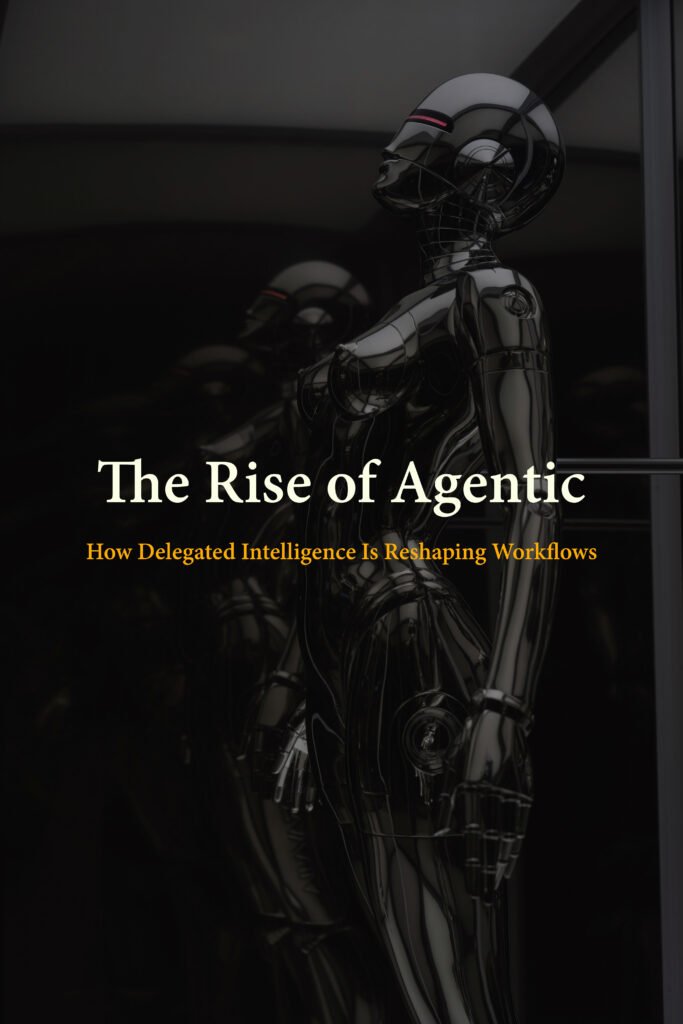
Artificial intelligence is evolving — and the next big step isn’t just smarter chatbots, but agentic AI: autonomous agents that can plan, act, and learn. Rather than waiting for user prompts, these systems take control, handle multi-step tasks, and make real-time decisions.
What Is Agentic AI?
Agentic AI refers to intelligent systems built from agents capable of reasoning, decision-making, and self-directed action. These agents can:
Perceive data from different sources
Break goals into smaller, actionable tasks
Execute these tasks (e.g., call APIs, trigger workflows)
Learn from feedback to improve future performance.
Unlike rigid automation, agentic workflows are adaptive — they adjust to changing conditions, learn from experience, and operate with minimal human oversight.
Why It Matters for Business
Agentic AI offers several big advantages:
Efficiency: Agents can take over repetitive, data-heavy tasks so teams can focus on strategy.
Scalability: They coordinate and self-organize, allowing workflows to scale naturally as business grows.
Better Decision-making: Agents reason and improve — reducing human error and continuous oversight.
Context Awareness: These systems remember previous interactions and dynamically plan their next steps.
Real-World Use Cases
Agentic AI is already being used across industries:
Customer Support: Agents can handle ticket routing, resolve common issues, or escalate complex cases.
DevOps & Software: AI agents monitor pipelines, triage bugs, or even roll back faulty releases.
HR Operations: Screening resumes, scheduling interviews, and onboarding can all be automated by agents.
Finance: In fintech, agents can conduct real-time risk analysis, compliance checks, and fraud monitoring.
Challenges to Watch
While powerful, agentic AI isn’t without risks:
Trust & Security: Giving agents access to systems can create vulnerabilities. Tatvic Analytics
Complex Coordination: Multi-agent systems may conflict or need orchestration. Wavestone
Accountability: When an agent makes a mistake, who’s responsible?
Maturity: According to analysts, many current agentic AI projects are still experimental and may not deliver clear ROI yet.
How Grafiqe Informatics Can Use Agentic AI
At Grafiqe Informatics, we see strong potential in harnessing agentic AI for:
Internal Automation: Implementing agentic workflows to automate project management, resource coordination, and operational tasks.
Client Solutions: Building AI-powered agent systems for customers (e.g., autonomous customer service bots, intelligent report generators).
Strategic Consulting: Helping businesses evaluate where to deploy agents, design workflows, and monitor performance.
Innovation & R&D: Experimenting with multi-agent systems, memory frameworks, and agent orchestration to enhance our product offerings.
The Road Ahead
Agentic AI is poised to become a cornerstone of enterprise automation. As companies look to scale intelligently, agents provide a way to delegate complex workflows while minimizing oversight. However, success requires careful planning: choosing the right workflows, ensuring data quality, and building guardrails.
At Grafiqe Informatics, we’re excited about this future — and ready to help you explore how agentic AI can transform your business. Let’s talk.